Avalanche kit: the essentials at a glance » video & more
12/25
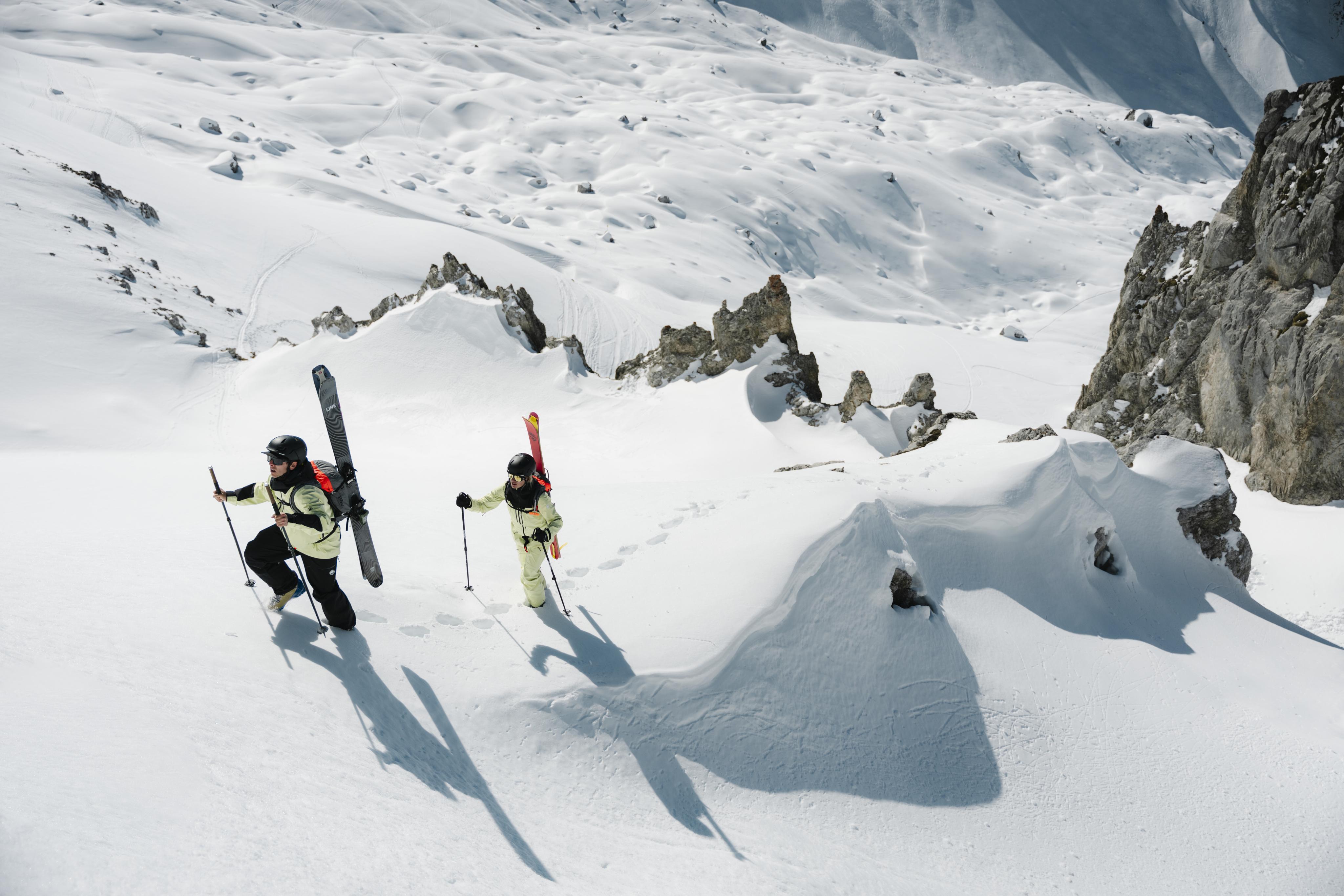
Whether freeriding, ski tours or splitboarding: When you’re venturing off the beaten track and ditching the safe surroundings of the piste, your own – and your groups’ – safety becomes paramount. Avalanche protection starts way before you hit the slopes. On top of considering factors like risk of avalanches, weather conditions, territory and group dynamics when planning your route, the right equipment is key.
The essential 4 of avalanche protection
Avalanche equipment comprises four essentials: an avalanche airbag , an avalanche transceiver , an avalanche probe , and an avalanche shovel . The airbag is designed to keep you afloat when being buried by the snow. The transceiver helps you locate buried victims, while the probe will determine their exact location and tell you how deep under the snow they are. With the shovel, you can quickly dig a buried person up.
Numbers from the Austrian Alpine Club show the importance of each component in avalanche rescue:
Transceiver + probe + shovel: average rescue time of 11 minutes
Transceiver + shovel (no probe): about 25 minutes
Transceiver only (no probe or shovel): up to 1 hour
Your chances of survival are highest in the first 10 minutes after going under. After that, they drop significantly: according to a Swiss study , when a rescue takes between 10 and 30 minutes, the chances of survival drop to just 31 percent. The good news: rescues happen much faster now. In peer rescues, half of all buried victims are recovered within 10 minutes, compared to 15 minutes a generation ago. So every piece of equipment you’re missing will cost you precious time in an emergency.
But how exactly do you use each component correctly, and what should you watch for? We’ve teamed up with mountain guide and freerider Nadine Wallner to explain the proper use of your avalanche safety equipment through a number of videos.
Please note: This article is not a substitute for a professional avalanche course, expert knowledge and regular practice. It is solely intended to provide you with the fundamentals to raise your awareness and act as a guide for selecting and using your equipment.


The avalanche airbag: your protection in the snow
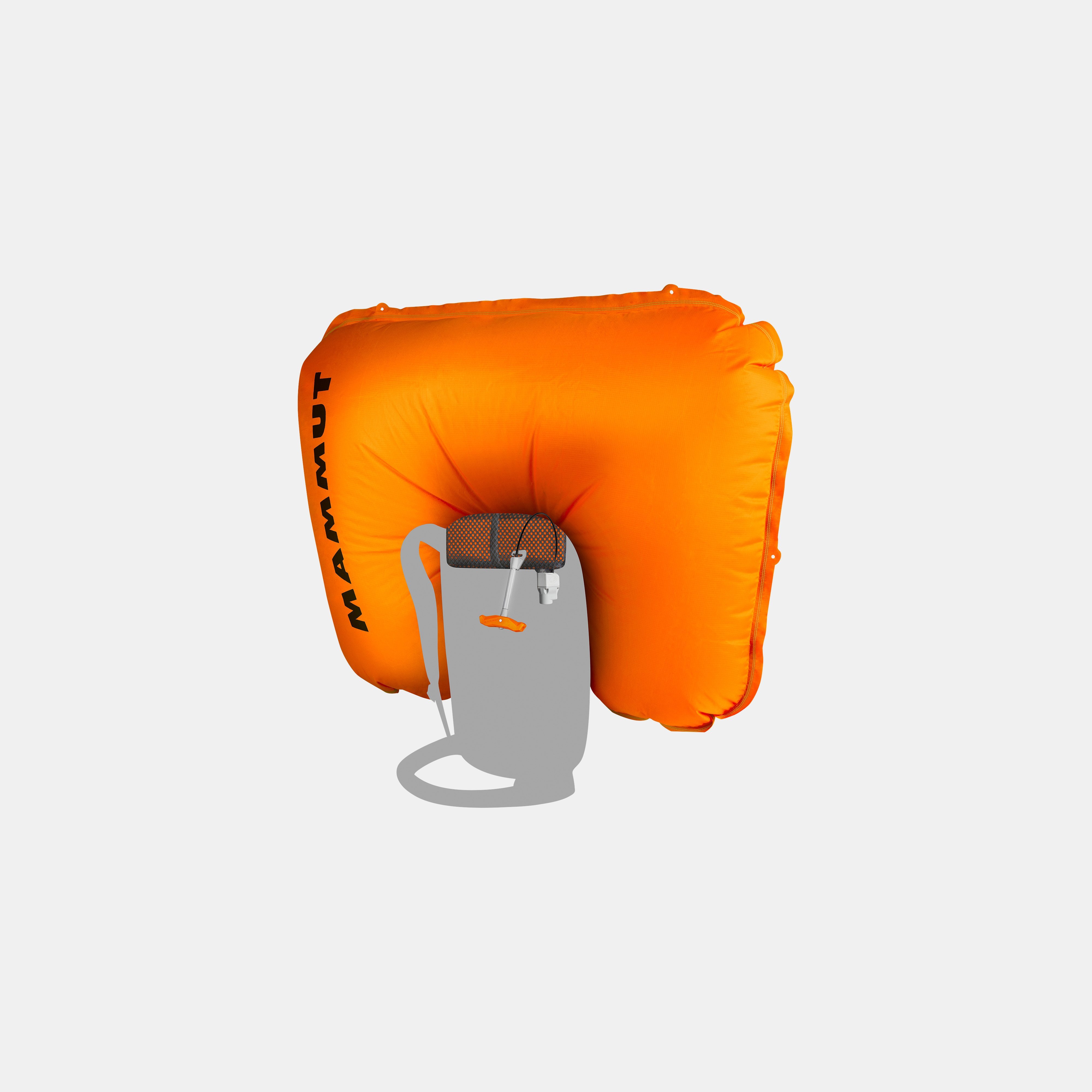
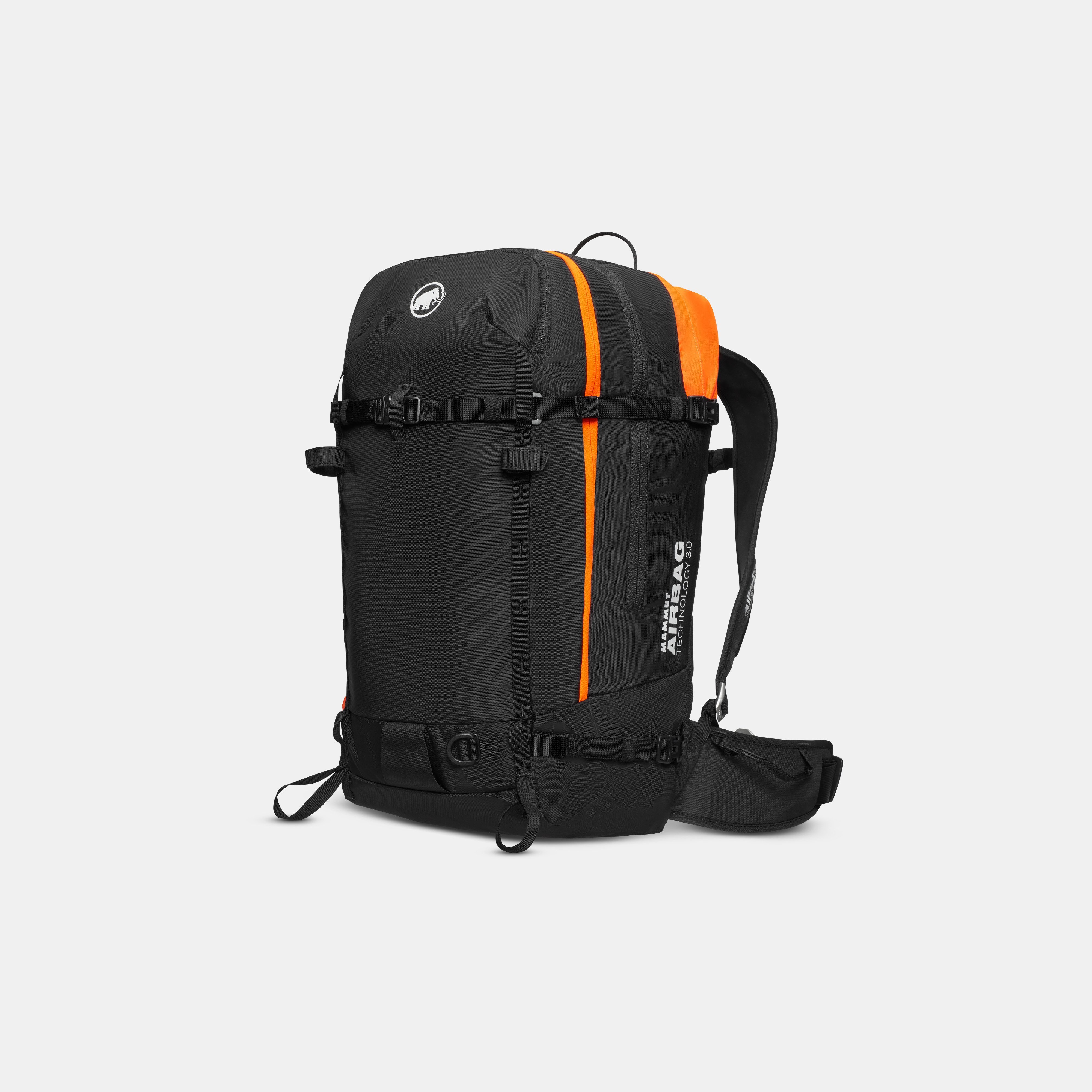
The avalanche airbag is the most visible part of your avalanche safety gear and one of the most effective ways to increase your chances of survival when caught in an avalanche *. When an avalanche strikes, pulling the release activates the airbag. It inflates in seconds, thus substantially increasing your volume. This increases your odds of staying on the avalanche surface, a physical principle known as inverse segregation: in a liquid mass, larger objects rise to the top.
*Source: Pascal Haegeli, Markus Falk, Emily Procter, Benjamin Zweifel, Frederic Jarry, Spencer Logan, Kalle Kronholm, Marek Biskupic, Hermann Brugger Haegeli p, et al.: The effectiveness of avalanche airbags. Resuscitation (2014)
The Mammut Removable Airbag System 3.0 deploys its 150-liter airbag within three seconds across your shoulders and behind your head. A refillable pressurized cartridge fills the airbag. The system weighs just 700 grams without the cartridge (1,010 grams with a carbon cartridge). The height-adjustable T-shaped release handle operates smoothly even with gloves on, and a safety leg loop prevents the pack from being ripped away in an avalanche. The "Removable" design also gives you plenty of flexibility: you can take the system out of one pack and install it in any other RAS 3.0-compatible Mammut ski backpack . So all you need is one airbag system, even if you use different pack sizes for different tours.
New to the Mammut lineup is the Haldigrat 30 E2 Airbag . This pack comes equipped with the electronic Alpride E2 Airbag System, which is powered by supercapacitor technology. That means you can trigger the airbag multiple times. The system is airline-approved and deploys quickly even in extreme cold.
The avalanche transceiver: your digital rescue device
The avalanche transceive r is the center piece of your avalanche safety equipment, capable of both transmitting and receiving a signal. In transmit mode, it sends a continuous signal on the standardized 457 kHz frequency. In case of an avalanche, the remaining group members can switch to search mode and follow the buried person's signal to locate them. Modern transceivers use three-antenna technology for precise direction and distance display.
Check our dedicated article to learn more about proper search technique with transceivers..
Your transceiver must always stay on your body, and should never go in your pack, since the sheer force of the avalanche can easily rip it off your back. Electronic devices like mobile phones must be kept a distance of at least 20 cm / about 8 inches in transmit mode, and at least 50 cm / about 20 inches in search mode, as they can interfere with the signal. This recommendation applies to Mammut avalanche transceivers as well. While the integrated Interference Guard will warn you of interference, it is not a substitute for keeping your electronic devices at the required distance.
Modern transceivers like the Mammut Barryvox boast a wide search range, intuitive controls, and precise search functions. The Barryvox S2 , for example, supports you throughout the search, showing you on its display into which direction you should move your device next. Even in complex scenarios with multiple buried victims, you can expect reliable results. What matters most is the device's signal processing. As an additional feature, both the Barryvox S2 and Barryvox 2 come with Bluetooth.
Tip: Only use batteries recommended by the manufacturer (2x AAA batteries for Barryvox 2 and S2, 3x AAA for Barryvox 1, and lithium batteries for Barryvox S2). Also make sure to remove them at the end of the season to prevent leakage. For devices that accept firmware updates, you should update these at the start of each season. A new firmware update for the Barryvox 2 and Barryvox S2 will arrive on December 15, 2026.
Learn more in our guide on how to Choose an Avalanche Transceiver.
The avalanche probe: precisely determining a location
Once you've narrowed down the buried person's location with your transceiver, the avalanche probe comes into play. You drive it straight down into the snow to pinpoint the exact location and determine the depth. Once the probe makes contact with the person, you can start the digging. The probe stays in place throughout the digging process to mark the exact position of the victim.
A quality probe is at least 240 cm / 94 inches long. Mammut probes are typically 280 cm / 110 inches to work even with larger avalanche cones. It should also be sturdy, and you should be able to quickly assemble it, even when wearing gloves. Mammut probes are UIAA-certified and equipped with a visual guide system with centimeter-accurate depth markings on both sides, clear 1-meter intervals, and color-coded end segments. This lets you determine the depth at a glance, and adjust your excavation strategy accordingly.
The avalanche shovel: efficient digging when it counts
Once you've located the buried person, it’s time to start digging with your avalanche shovel. Digging is the most time-consuming step in rescue and extremely difficult to do with bare hands, especially in compressed snow.
When it comes to avalanche shovels, durability and reliability are key. Blade size alone doesn't determine performance. In heavy snow, a smaller blade can be just as efficient, and is usually a good choice for smaller or weaker diggers. What matters is meeting the UIAA minimum size standard. All Mammut shovels are UIAA-certified and designed to provide maximum efficiency when shoveling. The Alugator Pro Light is one example, featuring the largest blade in the Mammut lineup while weighing just 675 grams. Additionally, the telescopic shaft and anti-slip handle are optimized for effective force transmission.
For those prioritizing weight, the Alugator Ultra is an excellent choice. This ISPO Award 2023-winner weighs just 395 grams, making it one of the lightest aluminum shovels on the market, and even fits into small backpacks thanks to its compact blade.
Avalanche equipment as a set: our Mammut packages
You can buy your transceiver, probe, and shovel in pre-configured sets. Not only do sets help you save money compared to buying each item separately, but every component will complement the others perfectly in terms of weight and size. At Mammut, you can choose from six sets:
Barryvox 1 Tour 280 Package : The dependable entry-level set with the Barryvox 1 (three-antenna transceiver), Probe 280 Speed Lock (UIAA, 310 g), and Alugator Ride SE (UIAA, 780 g).
Barryvox 1 Peak 240 Package : Combines the intuitive three-antennae Barryvox 1, the compact Alugator Peak shovel (580 g), and the space-saving Probe 240 (275 g, 45 cm / 18 inch packed length). Ideal for winter sports with light to moderate snowfall.
Barryvox 2 Tour 280 Package : For regular ski tourers. Equipped with the more powerful Barryvox 2 (70-meter search width, Interference Guard) plus the same probe and shovel as the Barryvox 1 Tour 280 Package.
Barryvox 2 Peak 240 Package : Contains the compact Barryvox 2 for fast, assisted search, paired with the Alugator Peak (580 g) and Probe 240 (275 g), both easy to use while wearing gloves.
Barryvox S2 Peak 240 Package : With the most advanced Barryvox model S2, this set offers the most comprehensive search support, even in challenging rescue situations. Includes the Probe 240 and Alugator Peak shovel.
Barryvox S2 Pro Light 280 Package : The premium set with the Barryvox S2 (digital/analog mode, intelligent fine search, W-Link) and the lighter Alugator Pro Light (645 g, largest blade).
Bonus: All sets come with the Barryvox carry system.
Checklist for every tour
Check the avalanche forecast
Run a group check with your transceivers (one person in search mode, all others walk past individually and confirm they've been detected)
Check your airbag: inspect the cartridge, release handle, and leg loop
Stow your probe and shovel in your pack for quick access
Define an emergency plan and set your communication methods
Other things to put in your backpack
Beyond the Essential 4, alpine clubs recommend these additional items as standard equipment for off-piste travel:
First aid kit including emergency blanket
Bivy sack
Mobile phone
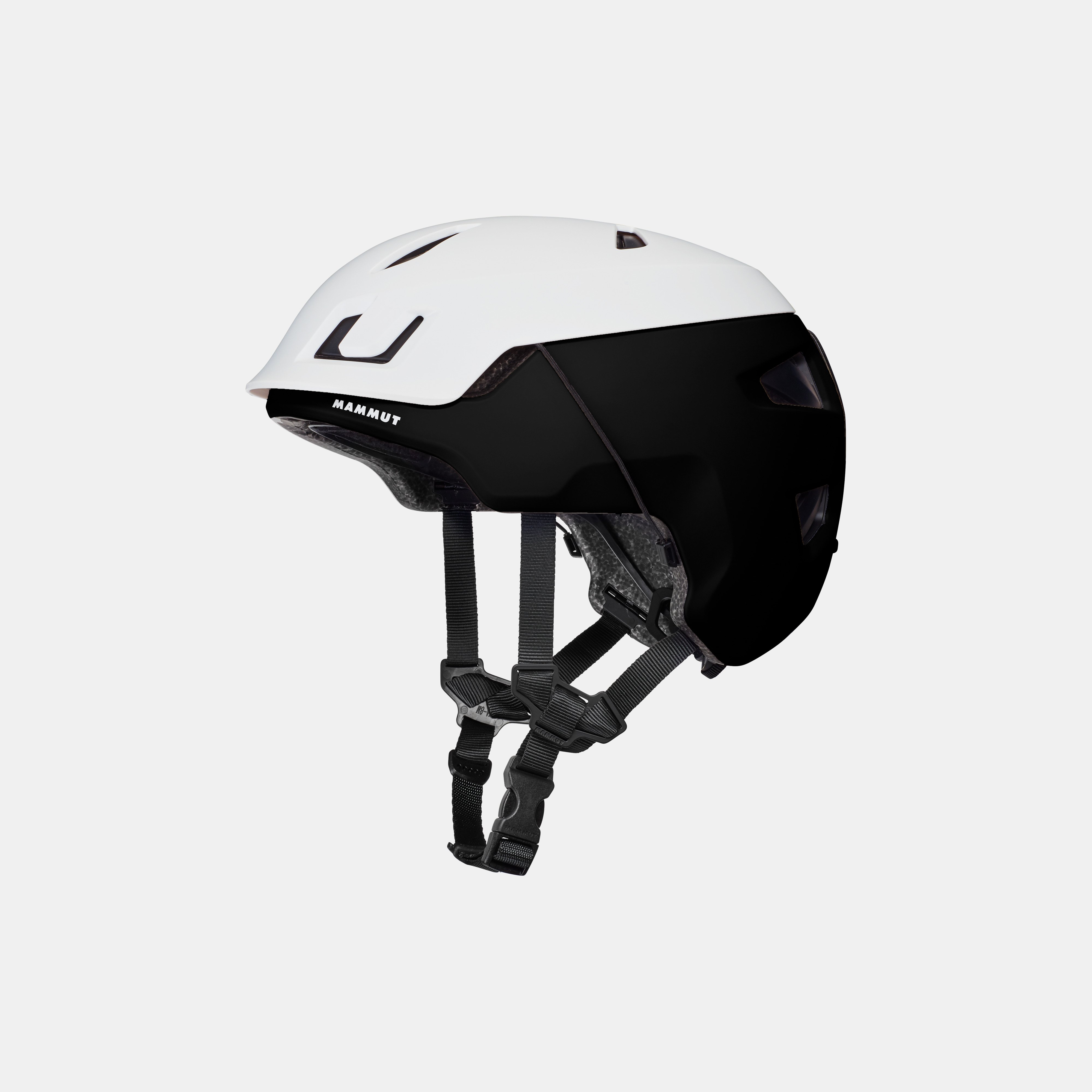
Helmet
Safety starts with the right knowledge and equipment
The Essential 4 are the key components of every off-piste tour. But they'll only ever be as good as the person using them. Practice, knowledge, and routine determine the outcome in life-or-death situations. So take the time to regularly check your equipment and practice using it. In our guide to avalanche transceiver training and search technique, we’ll walk you through the entire search sequence in four phases, from signal search through probing. Additionally, our Mammut Mountain School , the Mammut Avalanche Hub , and the Barryvox App provide even more practical tips, how-tos and training opportunities.
You'll also find more on ski tours and avalanche safety in our Mammut Stories & Guides , including a complete ski tour kit list , tips on what to wear for ski tours , and our guides to selecting the perfect ski tour pack and the right avalanche transceiver.
Find out more in our Mammut Avy Hub
Frequently asked questions
Which avalanche transceiver set is right for me?
It depends on how often you go on tours and what you require from your gear. For occasional tours, the Barryvox 1 Tour 280 Package will do the trick. Regular ski tourers tend to choose a Barryvox 2 Package , while professionals and serious athletes will get the most features with the Barryvox S2 Pro Light 280 Package .
Do I need an avalanche airbag in addition to my transceiver set?
An airbag isn't required, but it's a useful addition. It increases your odds of staying on the avalanche surface. Mammut counts the airbag pack alongside your transceiver, probe, and shovel among the Essential 4 of avalanche protection. However, it is not a substitute for standard equipment or the appropriate knowledge and training.
What makes up a complete avalanche kit?
The core equipment consists of an avalanche transceiver , avalanche probe , and avalanche shovel . Mammut counts the avalanche airbag as a fourth component (the Essential 4). Alpine clubs additionally recommend a first aid kit, bivy sack, mobile phone, and helmet.
What is an avalanche transceiver set?
A pre-configurated set of avalanche transceiver , probe , and shovel . Mammut offers six sets: the Barryvox 1 Tour 280 Package , Barryvox 2 Packages , and the Barryvox S2 Pro Light 280 Package .
How useful is an avalanche backpack?
Very useful. An avalanche pack with an airbag system doesn't prevent avalanches, but it's the only piece of safety equipment that can help you stay afloat when caught in the snow. While inflating the airbag will significantly increase your odds of not getting buried, it is no substitute for your transceiver set , expert knowledge, or training.
When do I need an avalanche transceiver?
The moment you leave the marked piste, whether freeriding, ski touring, or splitboarding. Every group member must wear an active device on their body, never in their pack.
How old can an avalanche transceiver be?
There's no legal expiration date, but manufacturers and alpine organizations recommend replacing transceivers after a maximum of 10 years. Mammut additionally recommends having your devices serviced every three years, especially after falls, exposure to moisture, or long periods of inactivity.